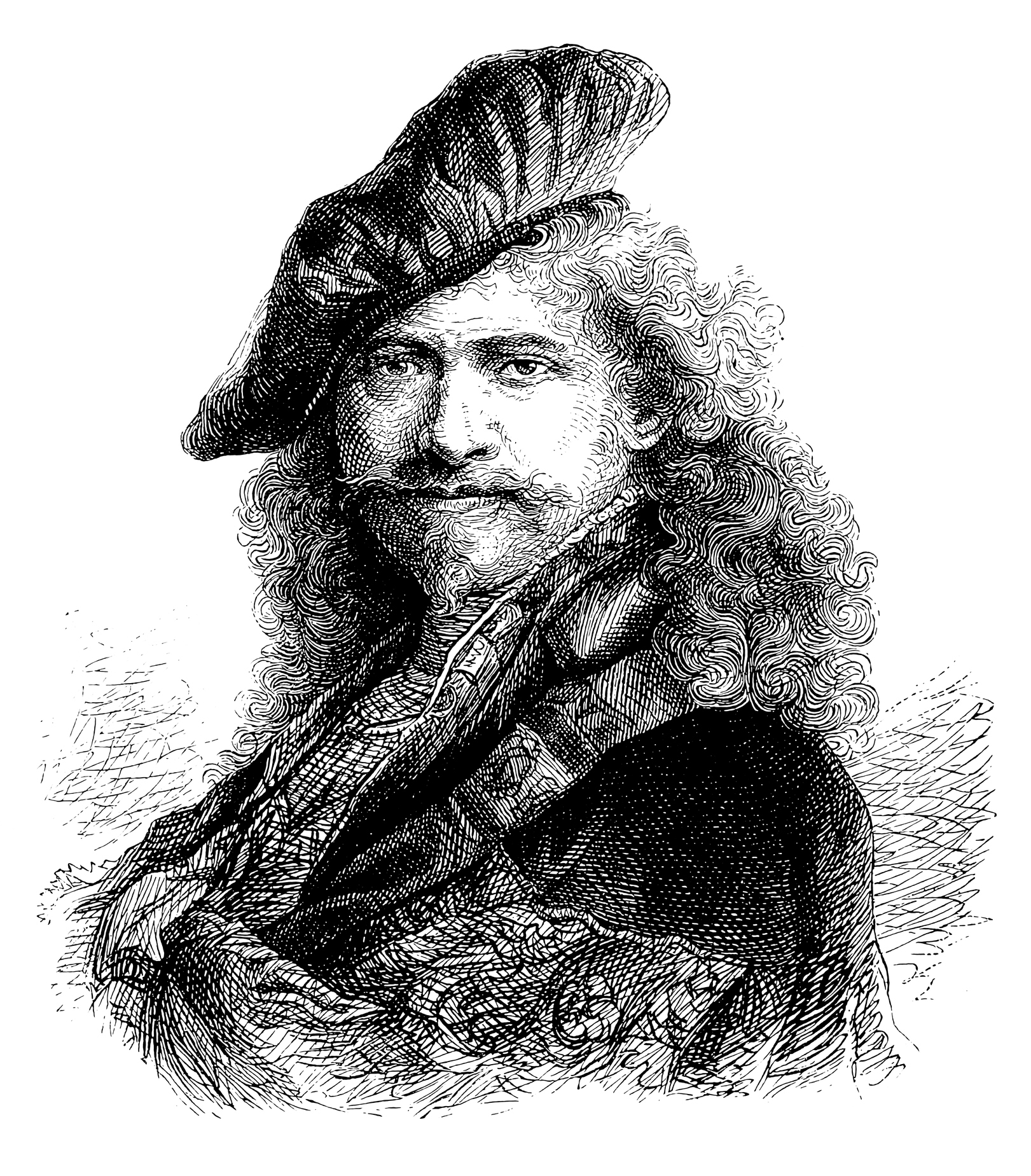
Rembrandt didn’t need to travel far to create powerful paintings and drawings. He found endless inspiration in everyday life in 17th-century Amsterdam. His true strength lay in looking closely: observing people, studying faces, and capturing both outer appearance and inner life.
Everyday Life as His Greatest Muse
He was deeply inspired by ordinary people; neighbors, beggars, family members, men and women from the street. Their faces, wrinkles and emotions fascinated him far more than idealized beauty. Rembrandt painted life as it truly was.
Himself as a Model: The Self-Portraits
Rembrandt often used himself as a model, not only in paintings but also in countless pen and ink drawings. His many self-portraits show how he experimented with light, expression and emotion. They also tell a personal story: of aging, success, ambition, and profound setbacks. Few artists have documented their own lives so honestly.
The Bible and Classical Stories
Biblical scenes played a major role in Rembrandt’s work, but he portrayed them in a strikingly human way. His figures are not distant saints, but people who doubt, feel and struggle. Alongside the Bible, he also drew inspiration from mythology and classical literature, always grounding grand stories in human emotion.
Light and Shadow
Rembrandt was fascinated by light—how it falls, what it reveals, and what it conceals. He studied the works of older masters and collected prints from across Europe. He learned by looking, copying and reinventing. Influenced by Italian masters such as Caravaggio, Rembrandt developed his own warmer, more intimate use of light and shadow, which became his unmistakable signature.
Amsterdam in Rembrandt’s Time
What was Amsterdam like in Rembrandt’s era? The bustling 17th-century city—full of trade, wealth, poverty and diversity—was an endless source of inspiration. Amsterdam provided Rembrandt with patrons, models and stories. The city was remarkably progressive for its time, thanks to advanced trade networks, relative freedom, and a flourishing of art, science and printing.
This was the era of the Dutch Golden Age, but that “golden glow” certainly did not shine on everyone. Society was vibrant, unequal and surprisingly modern all at once. So who were the people living in Amsterdam back then?
A City of Newcomers
Amsterdam grew at an astonishing pace. People arrived from all over Europe: merchants from Antwerp, Jewish communities from Spain and Portugal, workers from Germany and Scandinavia. The city was relatively tolerant for its time, as long as you worked, traded and didn’t disrupt public order.
Philosophical works banned elsewhere in Europe were printed in Amsterdam and secretly distributed abroad. Even the writings of the French philosopher René Descartes found a safe haven here. “In this city, there is no one but me who is not engaged in trade. Everyone is so absorbed in making money that I could live here my entire life without ever being noticed by anyone.” Do we take that as a compliment or not?
The Upper Class: Regents and Merchants
At the top of society were wealthy merchants, bankers and city regents. They lived along the canal belt, wore expensive clothing and invested heavily in art. These are the people Rembrandt often portrayed: confident and successful, yet frequently sober and restrained. Their wealth came from trade, shipping and colonial expansion through organizations such as the VOC.
The Middle Class: Craftsmen and Shopkeepers
A large and vital group: bakers, tailors, printers, painters and shopkeepers. They lived reasonably well but worked hard. Many could read and write, still uncommon in Europe at the time. This middle class formed the beating heart of the city.
The Lower Class: The Poor and the Marginalized
Not everyone benefited from Amsterdam’s prosperity. Day laborers, servants, widows, orphans and beggars lived precarious lives. Houses were small and crowded, hygiene was poor, child mortality was high, and much of life took place on the streets. Illness, unemployment or bad luck could quickly push someone to the margins of society. It is precisely these people who appear so often in Rembrandt’s drawings: real, vulnerable and deeply human.
The 17th-century Amsterdammer was no hero or saint, but a person of flesh and blood. That reality is visible in the art of the time—and especially in Rembrandt’s work. Amsterdam was rich and poor, devout and business-minded, harsh and creative all at once. A city of contrasts, just like the people who lived there.
Learn more about Rembrandt and the history of Amsterdam?
Let’s connect you to one of our history experts and go on a discovery live session with a private Flowently tutor in Amsterdam!
https://flowently.com/contact-us/